
Wednesday, 29 June 2016


Saturday, 18 June 2016

Wednesday, 15 June 2016
Tall and fair.
It is screaming out connection, connection, connection. 'There is no such thing as coincidence when you are dealing with serial killers.'
I know I've previously quoted that statement. I don't necessarily think that Jack the Ripper killed five women. Contemporary reports claim any number of victims. Three women stand out. They shared similarities and differed from the other Whitechapel murder victims by dint of their age and stature (average male height was 5ft. 5in. in 1888). :
The Whitehall Mystery victim. 2nd October 1888 over 24 or 25 and under 30. It appeared that she was full fleshed, well nourished. Stout. Dark hair, fair skin. 5ft. 8in.
Mary Kelly. 9th November approximately 25 years of age. Stout. Golden hair, fair skin. 5ft. 7in.
Elizabeth Jackson. 4th June 1889 under the age range of 25 Stout. Sandy coloured hair, fair skin. 5ft. 5 in.
Mary Kelly often visited The Elephant and Castle (south side of the river). Elizabeth's Jackson's torso was found just two miles distant in Battersea Park (south side of the river.) The Whitehall Mystery's torso was discovered about two miles from The Elephant and Castle and curiously approximately two miles from Battersea Park.

Monday, 13 June 2016
Alas an alias.
Date of Joining: 8 December 1879.
Date: 1879 Dec 8
Held by: The National Archives, Kew
Legal status: Public Record
Language: English
Closure status: Open Document, Open Description
Lavey Frederick — — 1878 British Army Service Records 1760-1915
George Sullivan alias Frederick Levy alias Frederick Lavey, born Waterford, Ireland.
Attestation papers to serve in the Royal Marines at Chatham 1878 (when aged 24).
Discharged 1879 as Worthless and Incorrigible.
Failed to report he had been previously invalided out of 9th Lancers.
Howell or Cook or Levy or Stock Thomas or Frederick — — 1887 England & Wales, Crime, Prisons & Punishment, 1770-1935.
I'd like to view this bloke's signature. I'm pursuing long shots!
Sunday, 12 June 2016
Plain for all to see.
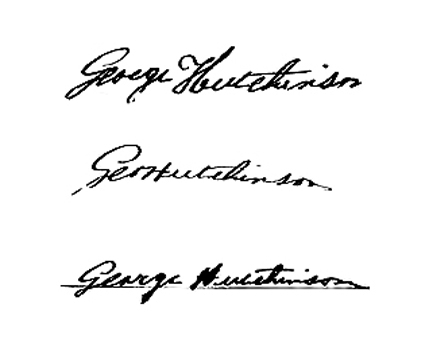
These are comparison George Hutchinson signatures and now the differences have been pointed out I can see them quite clearly.

 The upper loop on G remains within the cup on all of George Hutchinson's witness signatures. End stoke finishes down not up. Small case case h is looped on George Hutchinson's statement in all three cases. The E following the capital G is looped.
Mm, I wonder whether there's an uppercase G in any of the ripper letters ...?


Mm, I wonder whether there's an uppercase G in any of the ripper letters ...?
Friday, 10 June 2016
Who is George Hutchinson?
I handed a graphologist photocopies of George Hutchinson’s
signatures from his statement given at Commercial Street station on the 12th
Nov. He knew nothing of the person and isn’t someone who follows or has more
than rudimentary knowledge of Jack the Ripper. Hutchinson’s name meant nothing
to him and I separated the signatures from the statement.
This is what he said:
This person is old. The style of the writing
. . . and it’s shaky . . . tentative. It’s funny
. . . the George is confident but the surname is
. . . lacks . . . confidence . . . or
rhythm. He’s not used to writing this name. Is this his signature? I can
believe the George is his name. He’s accustomed to writing it. It is the same,
give or take the natural and expected variants form one signature to another.
Look at the H. He can’t decide how
to form it or how to connect it to the mid-zone following letter. He so lacks
assurance that the letter H is
blotted in this signature where his nib has dithered over the paper . . . and
see here . . . it’s almost as if . . . the
letters are reducing in size . . . he doesn’t want to write
this. Doesn’t want to be . . . I don’t know
. . . I’d say he’s embarrassed about it. Shy? Perhaps he’s
writing this name and it isn’t . . . his . . .
and he doesn’t like the lie . . . subconsciously
. . . Is that right?
Are you saying that Hutchinson isn’t his surname?
I don’t know . . . but he’s written the name
George with authority. If I were to guess I’d say this isn’t his surname and
whatever his surname . . . it probably doesn’t begin with the
letter H.
Tuesday, 7 June 2016
Mary Jane Kelly
Mary Jane Kelly's portrait from facial mapping.
Detective Inspector Walter Dew:
"All this was horrifying enough, but the mental picture of that sight which remains most vividly with me is the poor woman's eyes. They were wide open, and seemed to be staring straight at me with a look of terror".
Detective Inspector Walter Dew:
"All this was horrifying enough, but the mental picture of that sight which remains most vividly with me is the poor woman's eyes. They were wide open, and seemed to be staring straight at me with a look of terror".
Monday, 6 June 2016

Thursday, 2 June 2016
George Hutchinson's other 'arf.
George Hutchinson is irksome. I have read he worked as a
groom, presumably working with horses. He was stout and had military bearing and that
is about the sum of George Hutchinson.
Sarah Lewis, a laundress of 24 Great Pearl Street gave this statement
and description to the police:
He was not tall – but stout – had on a wideawake black hat –
I did not notice his clothes – another young man with a woman passed along –
The man standing in the street was looking up the court as if waiting for
someone to come out.
George Hutchison stated that he was outside Miller’s court
at the time commensurate with Lewis’s statement. So her description is
confirmed by George Hutchinson.
Israel Swcharz’s description of the attacker – Elizabeth
Stride:
At around 12.45am he turned into Berner Street and noticed a man walking
ahead of him. The man stopped to talk to a woman who was standing in the
gateway of Dutfield’s Yard. The man was about 5 feet, 5 inches tall, aged
around 30 with dark hair, a fair complexion, a small brown moustache. He had a
full face, broad shoulders and appeared to be slightly intoxicated.
William Marshall's description:
William Marshall lived at 64 Berner Street. He saw a couple kissing
on the pavement outside number 63. He heard the man tell the woman that she
would say 'anything but your prayers'.
According to Marshall the man was middle aged with the
appearance of a clerk He was about 5 foot 6 inches tall, somewhat stout,
respectably dresses and clean shaven. He wore a small, black, cutaway
coat, dark trousers, and a round cap with a small sailor-like peak cap.
The theme here is stout.
Aliases were used, not
infrequently, by army personnel – as I discovered when I found Alfred Long’s
army alias and included in my book ‘Long Arm of the Law’. A terrible pun but it
apes Alfred Long’s use of his alias, James Short. That sort of comedic in-joke
is reminiscent of some of the ‘humorous' Ripper letters. But anyway, George
Hutchinson hasn't been found (not convincingly) in the records. My guess is he used an alias. Was he
known as George Hutchinson in Whitechapel? We only have his word that he was.
He didn’t attend Mary Kelly’s inquest. Residents of Whitechapel couldn’t therefore
accuse him of not being who he claimed he was.
I’m wondering if he too was in the 9th Lancers -- old pals
with Alfred Long and working as a groom in this cavalry unit (soldiers looked
after their own horses but the army employed grooms). Which takes me back to
Lewis’s statement, ‘The man standing in the street was looking up the court as
if waiting for someone to come out’.
Perhaps he was.
Perhaps it was a serial killing pairing? A
not unknown phenomena:
Over one third of all serial murders are committed by teams. Most involve two offenders. 13 percent of all serial killers are male-female. Without exception, every group of offenders has one person who maintains control of the other members, whether through coercion, intimidation, or other persuasive techniques. Nearly all of these "leaders" are men. Although women are frequently involved with serial murder teams, they generally are not the decision-makers or main enforcers.
Most criminal teams quickly fall apart. Typically, they make a mistake, such as leaving a witness alive, quarrelling, or going further in brutality than one partner can bear.
The most dangerous teams involve male/male pairings, and of those, the most aggressive are equals who realise they now have a partner as depraved as they are. With no moral boundaries, they work together to affirm and expand their range of criminal creativity. Katherine M. Ramsland
The most dangerous teams involve male/male pairings, and of those, the most aggressive are equals who realise they now have a partner as depraved as they are. With no moral boundaries, they work together to affirm and expand their range of criminal creativity. Katherine M. Ramsland
Purely speculation on my part BUT ...
David Wilson Professor of Criminology at Birmingham City University:
It is screaming out connection, connection, connection. 'There is no such thing as coincidence when you are dealing with serial killers.'
David Wilson Professor of Criminology at Birmingham City University:
It is screaming out connection, connection, connection. 'There is no such thing as coincidence when you are dealing with serial killers.'
Wednesday, 1 June 2016
Serial killer deja vou.
Dennis Andrew Nilsen (born 23 November 1945, Fraserburgh, Scotland) also known as the Muswell Hill Murderer and the Kindly Killer is a British serial killer who lived in London.
Nilsen killed at least fifteen men and boys in gruesome circumstances between 1978 and 1983, and was known to retain corpses for sex acts. He was eventually caught after his disposal of dismembered human entrails blocked his household drains: the drain cleaning company found that the drains were congested with human flesh and contacted the police.
In 1961, at sixteen, Nilsen enlisted in the British Army and became a cook in Aden, Cyprus and Berlin. He became a cook, serving as a butcher in the Army Catering Corps, learning the skills that served him so well during his five-year killing spree. He left the army in 1972 and served briefly as a police officer.
This biography sounds familiar. Working in a kitchen. Even to the age at which he joined the army and following with joining the police force.
Serial killers seek occupations whereby they gain control of others.

Sunday, 29 May 2016
George Hutchinson's statement is too good to be true?
George Hutchinson's statement is too good to be true? Then it came to me and I should have spotted it earlier ...
Excerpt from George Hutchinson's statement:
'I stood against the lamp of the Queen’s Head Public House and watched him. They both came past me and the man hung his head down with his hat over his eyes. I stooped down and looked him in the face. He looked at me stern. They both went into Dorset Street. I followed them. They both stood on the corner of the court for about three minutes. He said something to her. She said: “All right, my dear. Come along. You will be comfortable”. He then placed his arm on her shoulder and she gave him a kiss. She said she had lost her handkerchief. He then pulled out his handkerchief, a red one, and gave it to her.'
There it is. Did you see his lie? No, and neither would any human because we don't perceive colour at night.
This is the physiological reason if you're interested:
There are two kinds of light-sensitive organs located in the backs of our eyes: rod-shaped and cone-shaped. Both rods and cones are sensitive to light. The difference between them is that the rods allow us to see in very dim light but don’t permit detection of colour, while the cones let us see colour but they don’t work in dim light.When it gets dark the cones lose their ability to respond to light. The rods continue to respond to available light, but since they cannot perceive colour, everything appears to be various shades of black and white and grey.
A little about coal gaslight:
Gaslights became brighter after 1885 with the invention of the gas mantle. I think it safe to assume that gaslights emitted a dull light even with the invention of the mantle, which I doubt were utilised in slum Whitechapel in 1888. Coal gaslight emits a yellow greenish tone and would degrade the colour red even if Mary Kelly and her punter were standing under a lamp post, which they weren't. The position of the lamp opposite no 13 (Mary Kelly's room) would not have cast light on the entrance to the court. So George Hutchinson couldn't have seen a red handkerchief from where, and when, they stood.
George Hutchinson may have seen a man give Kelly a red handkerchief, but earlier, under a brighter, and natural, light. 'He then pulled out his handkerchief, a red one, and gave it to her'. Hutchinson's critics are right. His observations are too detailed. He's lying, but why?
If Hutchinson's story regarding the red handkerchief is true, ignoring his stated time-frame, and he witnessed a man tie a red handkerchief about Mary Kelly's neck, then the symbolism of that action prior to her death is acute.
N.B George Hutchison spent all his money going down to Romford. It must have been for some other purpose than visiting Romford Market, which didn't/doesn't trade on Thursday.
Subscribe to:
Posts (Atom)