Showing posts with label George Hutchinson. Show all posts
Showing posts with label George Hutchinson. Show all posts
Saturday, 9 July 2016
George Hutchinson is lying.
George Hutchinson is lying. The question is not why – at the moment, but his reasoning. He didn’t see the gold-watch chain man, with Mary Kelly at two in the morning, as he stated. It is impossible for the human eye to detect colour in the dark –earlier blog.
So, Hutchinson walked to and from Romford in the hours preceding Mary Kelly’s slaughter? It wasn’t market day in Romford. If he did walk the twelve miles to Romford then whatever caused him to slog those miles was a call of duty. A family bereavement, which means George Hutchinson lives, lived, or has family in Essex?
I believe George Hutchinson did witness Mary Kelly with a man as described, but during the day. After all, if a lie is to convince best ensure it doesn’t vary from one statement to another. Tie the lie to a truth – hang it on fact. Otherwise, it's too easy to forget those little incriminating details. George Hutchinson recalled and recounted an event that occurred earlier but moved the occurrence to the night in question. There’s no reason a man wouldn’t wear a gold watch chain, in a main thoroughfare, in the middle of the day.
So what’s left is George’s interest in Mary Kelly. He states he stood outside her living space for three-quarters of an hour and even ventured into the small court. He also says he gave her money on occasion. He stated he had known her for three years, which means he met her after her arrival in London and when she worked as a prostitute in the Ratcliff area. It's not too difficult to work out why he gave her money.
A witness, Sarah Lewis, testified she saw a stout man standing looking up the alley as if he waited for someone. George Hutchinson came forward after the inquest had closed and made his bizarre, and obviously untrue, statement.
The question is what part of it is a lie?
Mary Kelly escorting a man with a gold chain and a red handkerchief, according to George Hutchinson’s description, is a lie.
Joe Barnett told Mary not to take other men while she was with him. So some time after the date of 30th October when Joe Barnett left Miller’s Court.
Romford is twelve hours from Whitechapel. He saw Mary Kelly at two in the morning in Commercial Street.
So walking at four miles an hour, he left Romford at eleven o’clock at night. As I’ve already said, it wasn't market day. And even if it were, it was an early morning market. It begs the question what was he doing from the market’s closure to his arrival in Whitechapel? It’s a three-hour walk to Essex and another three hours return journey but he lurks on a dismal drizzly night in Dorset Street watching an alley? It doesn’t make sense.
I don’t think his visit to Romford was that day. So perhaps he did visit the market, just on a different day and the man he saw with Kelly was a different time from his stated date. The market in Romford opens at six in the morning. So George would have left Whitechapel at three in the morning. The market closes at two. He would have returned to Whitechapel at four in the afternoon at the earliest. Enough time to witness Mary Kelly meet a punter in Commercial Street. If he’d been to Romford market, surely it was to find work? If that is the case, why didn’t he have any money? He says, when Mary Kelly asked if he would lend her a sixpence, he replied that he’d spent all his money going to Romford. Not to work then? Or perhaps he didn’t find someone willing to hire him when he arrived there? Okay, so he’s not going to Romford to make money but he’s spent money. Which leads me back to where has a link to Essex other than the market.
So if he is lying what other lies is he telling and why? He places himself in the frame. No one knew it was he until he confesses. He made his statement given only after the inquest’s closure. But he doesn’t know what that witness said. But then something prompted his arrival at Commercial Street police station after he heard that a stout man was seen in Dorset Street. Perhaps she knows him? Or perhaps he recognised her? She was intent in finding sanctuary from an abusive husband in the early hours of the morning on a dismally damp night. I expect she tucked herself in her shawl and ignored him – signalling she wasn’t for hire. She wouldn’t have made eye content with him. But he saw and stared at her. But if he recognised her, he didn’t know if she recognised him. Word was out about the killing and the inquest. But he didn’t arrive until its closure. So something unnerved him . . . Just thinking aloud.
So he didn’t go to Romford to visit the market.
What we have is man who was roaming the streets at two in the morning. Why? He had a doss but he had no money to give Mary Kelly the sixpence she requested. Or so he says.
A man wandering the streets in the early hours of the morning? He sees Mary Kelly. She’s broke and desperate. They have known each other for three years but they refer, according to George Hutchinson’s statement, with their titles – Mary Kelly calls him Mr Hutchinson. No friendly chat here. It is formal. Perhaps that was the Victorian, ‘cover up the piano legs’ style of prim etiquette? But not on these mean streets. This isn’t the bourgeoisie.
Perhaps Mary Kelly did meet George Hutchinson that night. Perhaps he did say he didn’t have any money. But perhaps his mate did? Perhaps that’s who George Hutchinson waited for that night as he peered down that alley? George Hutchinson waited for someone. His mate who was with Kelly. He had the sixpence she wanted. Do serial killers work in pairs? Yes, apparently they do. But that presupposes George Hutchinson knew his mate was a killer.
I think George Hutchinson isn’t called Hutchinson – previous blog. He has family in Essex and he knew Jack the Ripper.


Friday, 10 June 2016
Who is George Hutchinson?
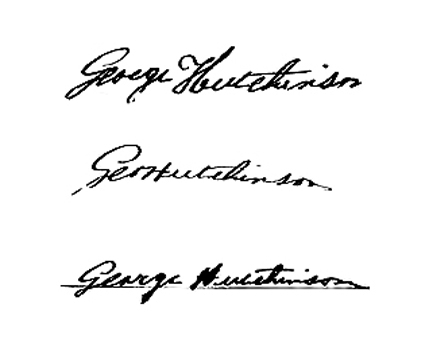
I handed a graphologist photocopies of George Hutchinson’s
signatures from his statement given at Commercial Street station on the 12th
Nov. He knew nothing of the person and isn’t someone who follows or has more
than rudimentary knowledge of Jack the Ripper. Hutchinson’s name meant nothing
to him and I separated the signatures from the statement.
This is what he said:
This person is old. The style of the writing
. . . and it’s shaky . . . tentative. It’s funny
. . . the George is confident but the surname is
. . . lacks . . . confidence . . . or
rhythm. He’s not used to writing this name. Is this his signature? I can
believe the George is his name. He’s accustomed to writing it. It is the same,
give or take the natural and expected variants form one signature to another.
Look at the H. He can’t decide how
to form it or how to connect it to the mid-zone following letter. He so lacks
assurance that the letter H is
blotted in this signature where his nib has dithered over the paper . . . and
see here . . . it’s almost as if . . . the
letters are reducing in size . . . he doesn’t want to write
this. Doesn’t want to be . . . I don’t know
. . . I’d say he’s embarrassed about it. Shy? Perhaps he’s
writing this name and it isn’t . . . his . . .
and he doesn’t like the lie . . . subconsciously
. . . Is that right?
Are you saying that Hutchinson isn’t his surname?
I don’t know . . . but he’s written the name
George with authority. If I were to guess I’d say this isn’t his surname and
whatever his surname . . . it probably doesn’t begin with the
letter H.
Thursday, 2 June 2016
George Hutchinson's other 'arf.
George Hutchinson is irksome. I have read he worked as a
groom, presumably working with horses. He was stout and had military bearing and that
is about the sum of George Hutchinson.
Sarah Lewis, a laundress of 24 Great Pearl Street gave this statement
and description to the police:
He was not tall – but stout – had on a wideawake black hat –
I did not notice his clothes – another young man with a woman passed along –
The man standing in the street was looking up the court as if waiting for
someone to come out.
George Hutchison stated that he was outside Miller’s court
at the time commensurate with Lewis’s statement. So her description is
confirmed by George Hutchinson.
Israel Swcharz’s description of the attacker – Elizabeth
Stride:
At around 12.45am he turned into Berner Street and noticed a man walking
ahead of him. The man stopped to talk to a woman who was standing in the
gateway of Dutfield’s Yard. The man was about 5 feet, 5 inches tall, aged
around 30 with dark hair, a fair complexion, a small brown moustache. He had a
full face, broad shoulders and appeared to be slightly intoxicated.
William Marshall's description:
William Marshall lived at 64 Berner Street. He saw a couple kissing
on the pavement outside number 63. He heard the man tell the woman that she
would say 'anything but your prayers'.
According to Marshall the man was middle aged with the
appearance of a clerk He was about 5 foot 6 inches tall, somewhat stout,
respectably dresses and clean shaven. He wore a small, black, cutaway
coat, dark trousers, and a round cap with a small sailor-like peak cap.
The theme here is stout.
Aliases were used, not
infrequently, by army personnel – as I discovered when I found Alfred Long’s
army alias and included in my book ‘Long Arm of the Law’. A terrible pun but it
apes Alfred Long’s use of his alias, James Short. That sort of comedic in-joke
is reminiscent of some of the ‘humorous' Ripper letters. But anyway, George
Hutchinson hasn't been found (not convincingly) in the records. My guess is he used an alias. Was he
known as George Hutchinson in Whitechapel? We only have his word that he was.
He didn’t attend Mary Kelly’s inquest. Residents of Whitechapel couldn’t therefore
accuse him of not being who he claimed he was.
I’m wondering if he too was in the 9th Lancers -- old pals
with Alfred Long and working as a groom in this cavalry unit (soldiers looked
after their own horses but the army employed grooms). Which takes me back to
Lewis’s statement, ‘The man standing in the street was looking up the court as
if waiting for someone to come out’.
Perhaps he was.
Perhaps it was a serial killing pairing? A
not unknown phenomena:
Over one third of all serial murders are committed by teams. Most involve two offenders. 13 percent of all serial killers are male-female. Without exception, every group of offenders has one person who maintains control of the other members, whether through coercion, intimidation, or other persuasive techniques. Nearly all of these "leaders" are men. Although women are frequently involved with serial murder teams, they generally are not the decision-makers or main enforcers.
Most criminal teams quickly fall apart. Typically, they make a mistake, such as leaving a witness alive, quarrelling, or going further in brutality than one partner can bear.
The most dangerous teams involve male/male pairings, and of those, the most aggressive are equals who realise they now have a partner as depraved as they are. With no moral boundaries, they work together to affirm and expand their range of criminal creativity. Katherine M. Ramsland
Purely speculation on my part BUT ...
David Wilson Professor of Criminology at Birmingham City University:
It is screaming out connection, connection, connection. 'There is no such thing as coincidence when you are dealing with serial killers.'
Sunday, 29 May 2016
George Hutchinson's statement is too good to be true?
George Hutchinson's statement is too good to be true? Then it came to me and I should have spotted it earlier ...
Excerpt from George Hutchinson's statement:
'I stood against the lamp of the Queen’s Head Public House and watched him. They both came past me and the man hung his head down with his hat over his eyes. I stooped down and looked him in the face. He looked at me stern. They both went into Dorset Street. I followed them. They both stood on the corner of the court for about three minutes. He said something to her. She said: “All right, my dear. Come along. You will be comfortable”. He then placed his arm on her shoulder and she gave him a kiss. She said she had lost her handkerchief. He then pulled out his handkerchief, a red one, and gave it to her.'
There it is. Did you see his lie? No, and neither would any human because we don't perceive colour at night.
This is the physiological reason if you're interested:
There are two kinds of light-sensitive organs located in the backs of our eyes: rod-shaped and cone-shaped. Both rods and cones are sensitive to light. The difference between them is that the rods allow us to see in very dim light but don’t permit detection of colour, while the cones let us see colour but they don’t work in dim light.When it gets dark the cones lose their ability to respond to light. The rods continue to respond to available light, but since they cannot perceive colour, everything appears to be various shades of black and white and grey.
A little about coal gaslight:
Gaslights became brighter after 1885 with the invention of the gas mantle. I think it safe to assume that gaslights emitted a dull light even with the invention of the mantle, which I doubt were utilised in slum Whitechapel in 1888. Coal gaslight emits a yellow greenish tone and would degrade the colour red even if Mary Kelly and her punter were standing under a lamp post, which they weren't. The position of the lamp opposite no 13 (Mary Kelly's room) would not have cast light on the entrance to the court. So George Hutchinson couldn't have seen a red handkerchief from where, and when, they stood.
George Hutchinson may have seen a man give Kelly a red handkerchief, but earlier, under a brighter, and natural, light. 'He then pulled out his handkerchief, a red one, and gave it to her'. Hutchinson's critics are right. His observations are too detailed. He's lying, but why?
If Hutchinson's story regarding the red handkerchief is true, ignoring his stated time-frame, and he witnessed a man tie a red handkerchief about Mary Kelly's neck, then the symbolism of that action prior to her death is acute.
N.B George Hutchison spent all his money going down to Romford. It must have been for some other purpose than visiting Romford Market, which didn't/doesn't trade on Thursday.
Subscribe to:
Posts (Atom)