Now, in a new report, ‘The Mary Jane Kelly Project’,
the research team has revealed the likelihood of locating and
identifying the last known victim of Britain’s most infamous serial
killer known as ‘Jack the Ripper’, who is thought to have killed at
least five young women in the Whitechapel area of London between August
and November 1888.
The team conducted a desk-based assessment of the burial location of Mary Jane Kelly and visited
St Patrick’s Catholic Cemetery, Leytonstone, on 3 May 2016 in order to
examine the burial area. Research was carried out in the cemetery’s
burial records and a survey of marked graves in the area around Kelly’s
modern grave marker was undertaken.
Dr King concluded: “As information presently
stands, a successful search for Kelly’s remains would require a
herculean effort that would likely take years of research, would be
prohibitively costly and would cause unwarranted disturbance to an
unknown number of individuals buried in a cemetery that is still in
daily use, with no guarantee of success.
“As such it is extremely unlikely that any application for an
exhumation licence would be granted. The simple fact is, successfully
naming someone in the historical record only happens in the most
exceptional of cases.
“Most human remains found during excavations remain stubbornly, and
forever, anonymous and this must also be the fate of Mary Jane Kelly.”
Thursday, 30 March 2017


Wednesday, 29 March 2017

Sunday, 26 March 2017
Black aprons and Goulston Street
I
reread Walter Dew's memoirs - the link? North London and hair
curlers! Anyway, Walter Dew stated that Catherine Eddowes wore a black apron. I’d always imagined Victorian working-class women wore white aprons, so I checked. There are photographs of women in dark-hued aprons with and without patterns. It takes little thought to understand a dark apron is more practical than white. If Eddowes apron was black or dark, how would Alfred Long see it in a dark entry? In the gloom, white cloth would have been difficult enough to see on that overcast, drizzly, night, but black? A mere shadow at the foot of the jamb that’s how it would have appeared and, at that stage, PC Long wasn’t yet aware a murder had occurred, or so he said. Peculiar he found the cloth so interesting – strange that he saw it at all.


Thursday, 23 March 2017
Connection. BJ Helston
A tweak. Getting there, at least it no longer looks like the cover of Vogue. I might just change the title... Bully, a pimp/bouncer at a brothel.


Wednesday, 22 March 2017
Connection. Billy Helston
First sketch of book cover. Whether this remains, I've no idea. I like the idea of the postcards scattered on newspaper -- as the book is in part about Emily Dimmock -- whose rising sun postcard was discovered tucked behind a sheet of newspaper lining a drawer.
Not sure the font is right ...

Not sure the font is right ...
Monday, 20 March 2017
1897 police statement
1897 police statement: There are three theories. The unfortunate lady might died accidentally, or there is the possibility of suicide, or there is the still more terrible supposition of murder. All these possibilities are the subject of consideration and investigation. Erm, with that degree of intelligent detection the mystery surprisingly remained unsolved . . .
Thursday, 16 March 2017
Phyllis Dimmock.
The Camden Town Murder, 1907. On 11th September 1907, Emily Dimmock (known as Phyllis), was murdered in her home at 29 St Paul's Road, Camden. Bertram Shaw discovered Phyllis naked on the bed with her throat cut so deeply she was nearly decapitated.


Wednesday, 15 March 2017

Mercedes Marie : The Story of Mary Jane Kelly.
Mercedes Marie : The story of Mary Jane Kelly
The dreadful events in Miller’s Court are only touched on at the end of this novel. For most of the book Billy Helston concerns herself with Mary Kelly’s life growing up in a colliery village near Wrexham and her years as a prostitute in Cardiff, London, and Paris. On the surface it’s a gritty tale of Victorian working class life shaped by poverty, tragedy, and violence. But what gives this novel special resonance is the author’s perceptive evocation of the close-knit mining communities of north Wales and the impoverished neighbourhoods of the East End: she delineates wonderfully the ties of love, resentment, need, and sympathy that bind people together and the reserves of toughness and compassion they draw on to survive. What starts out as the story of an ‘ordinary’ life in the Denbighshire hills quickly develops into something much bigger: by delving deeply into one person’s tragedy, Mercedes Marie illuminates broader truths about life and death.
Familiar figures jostle for space with characters not usually associated with the Mary Kelly story, such as Charlie Hammond, the violent landlord of the Cleveland Street brothel, and Alfred Long, the Metropolitan police constable who strikes up an intense bond with Mary. Helston has her own ideas about the identities of Mary Kelly and Jack the Ripper, and at the back of the book (separate from the story) there is a hefty appendix containing census data, newspaper reports, explanatory notes, and other material.
The book is full of sorrow and anguish, but there is humour as well, and bawdiness, and warmth. Even amid the brutality and the drab routine of Mary Kelly’s life there are small triumphs and moments of joy and surprise - a slice of Dundee cake in a Marylebone café, a dwarf in a Paris whorehouse with a parrot on its shoulder, Welsh dragons caught in the flue at Miller’s Court. Ripperologist NO 151 August 2016 Ripper Fiction Reviews, DAVID GREEN
The dreadful events in Miller’s Court are only touched on at the end of this novel. For most of the book Billy Helston concerns herself with Mary Kelly’s life growing up in a colliery village near Wrexham and her years as a prostitute in Cardiff, London, and Paris. On the surface it’s a gritty tale of Victorian working class life shaped by poverty, tragedy, and violence. But what gives this novel special resonance is the author’s perceptive evocation of the close-knit mining communities of north Wales and the impoverished neighbourhoods of the East End: she delineates wonderfully the ties of love, resentment, need, and sympathy that bind people together and the reserves of toughness and compassion they draw on to survive. What starts out as the story of an ‘ordinary’ life in the Denbighshire hills quickly develops into something much bigger: by delving deeply into one person’s tragedy, Mercedes Marie illuminates broader truths about life and death.
Familiar figures jostle for space with characters not usually associated with the Mary Kelly story, such as Charlie Hammond, the violent landlord of the Cleveland Street brothel, and Alfred Long, the Metropolitan police constable who strikes up an intense bond with Mary. Helston has her own ideas about the identities of Mary Kelly and Jack the Ripper, and at the back of the book (separate from the story) there is a hefty appendix containing census data, newspaper reports, explanatory notes, and other material.
The book is full of sorrow and anguish, but there is humour as well, and bawdiness, and warmth. Even amid the brutality and the drab routine of Mary Kelly’s life there are small triumphs and moments of joy and surprise - a slice of Dundee cake in a Marylebone café, a dwarf in a Paris whorehouse with a parrot on its shoulder, Welsh dragons caught in the flue at Miller’s Court. Ripperologist NO 151 August 2016 Ripper Fiction Reviews, DAVID GREEN
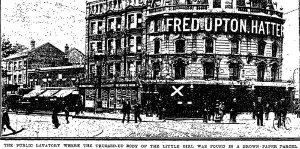
Mary Bailes.
The cross marks the spot where a lavatory attendant discovered the broken body of six year old Mary Bailes.
Tuesday, 14 March 2017
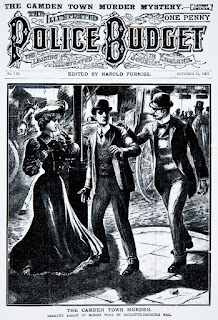
Robert Wood's arrest
Robert Wood, a talented artist, accused of the murder of Emily Dimmock 1907. His arrest.

Monday, 13 March 2017
Marie Ellen Bailes.
Marie Ellen Bailes. B J Helston. Opening chapter -- at the moment.
Pretty little six-year-old Marie Ellen Bailes left her home on Friday 30th May 1908, and her parents never saw her alive again. She had her mother’s colouring, with fair hair, blue eyes, a pale skin but topped with rosy cheeks. She wore a black skullcap dressed with two silk-ribbon rosettes, black stockings; boots, slightly scuffed at the toes, a white pinafore, a blue-check dress, and a pure silver necklace with a medal of the Virgin Mary about her neck. Her father, Alfred, was ex-army. Unlike most men at his work, he didn’t spend his lunch hour at the pub. He went home and ate with his family. Not that he was a teetotaller. He liked a drink as much as the next man, but he felt he’d done that. He’d seen much and experienced more than most in his military career. He now took his pleasure in his family – one boy and one girl.
Pretty little six-year-old Marie Ellen Bailes left her home on Friday 30th May 1908, and her parents never saw her alive again. She had her mother’s colouring, with fair hair, blue eyes, a pale skin but topped with rosy cheeks. She wore a black skullcap dressed with two silk-ribbon rosettes, black stockings; boots, slightly scuffed at the toes, a white pinafore, a blue-check dress, and a pure silver necklace with a medal of the Virgin Mary about her neck. Her father, Alfred, was ex-army. Unlike most men at his work, he didn’t spend his lunch hour at the pub. He went home and ate with his family. Not that he was a teetotaller. He liked a drink as much as the next man, but he felt he’d done that. He’d seen much and experienced more than most in his military career. He now took his pleasure in his family – one boy and one girl.
Subscribe to:
Posts (Atom)